
Exeter Oven Cleaning
Single and double oven cleaning
The standard job: a built in or freestanding oven stripped, soaked, cleaned by hand and rebuilt, usually inside the two hour minimum.
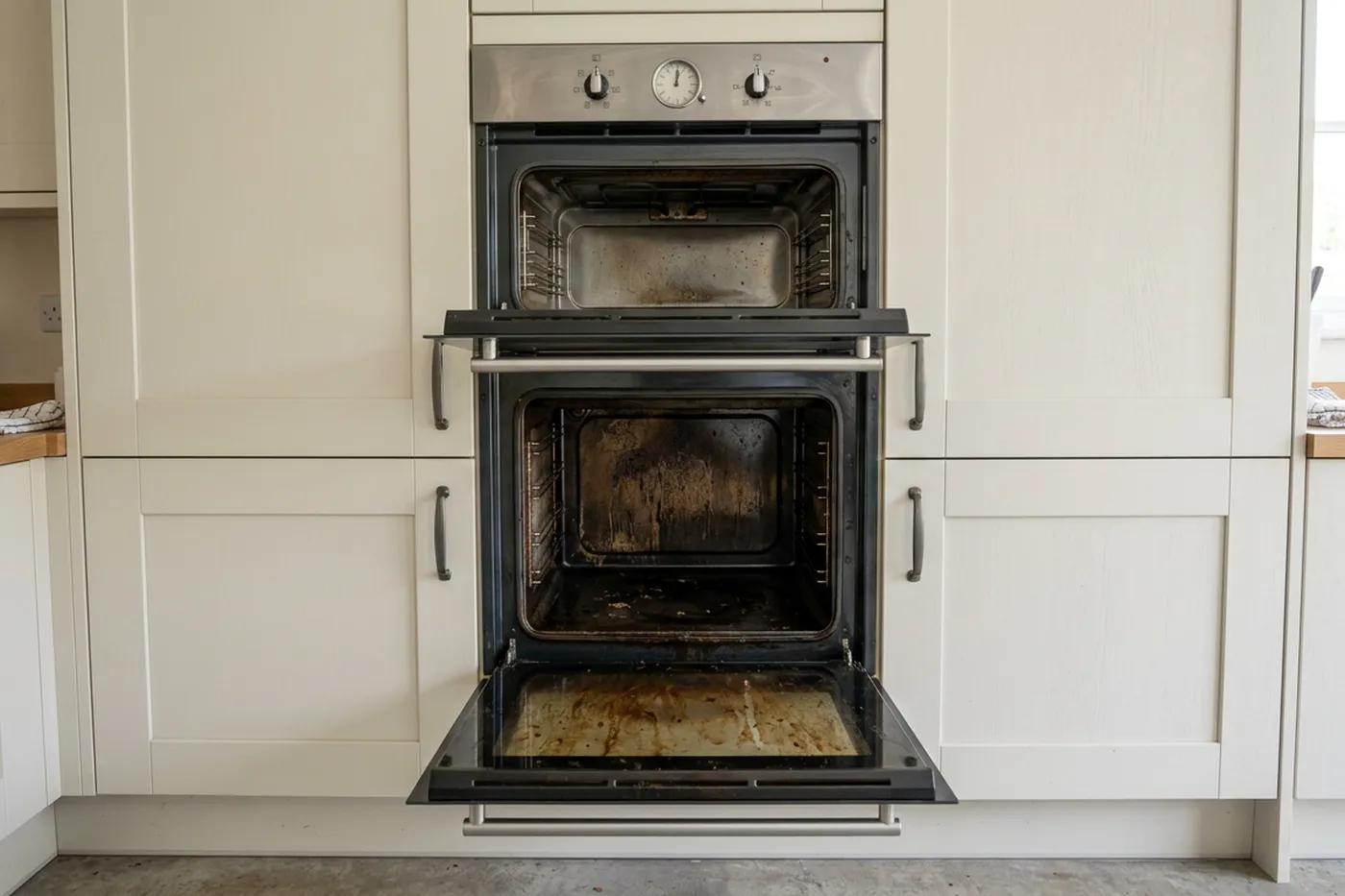
This is most of the work. A built in single or double oven, a fan oven under a hob, or a freestanding cooker in a rented flat. The cabinet has carbon on the roof and the back, the racks are sticky rather than dirty, and the door glass has gone the colour of weak tea.
The whole thing comes apart as far as the manufacturer intends. Racks, runners, trays and the oven liners where they lift out, all into degreaser. While they soak, the cabinet is done by hand, roof first, because everything that comes off the roof lands on the floor of the oven and gets picked up at the end.
A cooker in this shape almost always fits the 2 hours minimum, which is £120. If yours has a grill compartment and a second oven and has not been touched in a few years, it may run a little past that, and you will be told before it does.
What is included
- Oven cabinet: roof, floor, back, sides and the fan cover
- Racks, shelf runners and baking trays soaked and brought back to bare metal
- Door glass cleaned on both faces, and between the panes where the door separates
- Door seal cleaned in place and checked, not pulled out
- Grill compartment and grill pan where there is one
- Bulb cover cleaned and the bulb checked
- The frame, hinges and the gap the door closes onto
- Cooker slid back and the floor and units cleaned down
The bit between the door panes
Almost every complaint about a half done oven clean is about the glass. From the outside a door looks clean; from the front of the kitchen it still looks brown, because the film is on the inside faces of the panes rather than the ones you can reach.
Most domestic oven doors are designed to come apart, either by lifting the door off its hinges and releasing the inner panel or by removing a trim from the top edge. Where a door does separate, it is separated and the inner faces are cleaned. Where a manufacturer has bonded the assembly and it does not come apart at all, you are told that rather than being charged for a result that was never available.
Self cleaning liners and pyrolytic ovens
Some ovens have catalytic liners on the side walls, a rough matt panel designed to absorb grease and burn it off at temperature. Those liners are not scrubbed and no degreaser goes near them, because both wreck the coating. They are wiped and left, and the rest of the cabinet is cleaned around them.
A pyrolytic oven has its own scorching cycle and does not need a chemical clean inside, but the racks, the runners, the door glass and the door seal still do, and those are the parts the cycle leaves alone. People are often surprised how much of a pyrolytic oven still wants doing by hand.
What a clean will not fix
Enamel that has been pitted by a spill left to burn stays pitted. Door glass that has gone milky from heat is a chemical change in the glass itself, not a coating on it. A seal that has hardened and shrunk needs replacing.
All three come up looking better once the grease around them is gone, and none of them go away. They will be pointed out with a plain view on whether they matter, and in most cases they do not: an oven with a pitted floor cooks exactly as well as one without.
On the day
How a ovens runs
Cover the floor
Sheet down, units masked where they will be splashed, and a soaking tray set up out of the way of the traffic through the kitchen.
Strip and soak
Racks, runners, trays and liners out and into degreaser. The soak is what does the heavy lifting on those parts, and it starts first for that reason.
Cabinet by hand
Degreaser onto the roof and the back, left to sit, then worked off. A scraper only on the flat glass and steel, never across the enamel.
Rebuild and run it
Everything dried and refitted, door reassembled, and the oven brought up to temperature so the last of the cleaner smell burns off rather than turning up in your food.
Behind the work
Kit, cover and qualifications
One person, named
Sam Hembury does the work himself. The person who gives you the estimate is the person standing in your kitchen.
Hembury Contracting
Exeter Oven Cleaning is a service line of Hembury Contracting, Sam's Exeter contracting business. Same trading entity, same invoices, same VAT registration.
Public liability cover
Insured for work in your home. A copy of the certificate goes over by email if you want to see it before booking.
By hand, with time
Professional degreasers, removable parts soaked, cabinet and glass done by hand. No shortcuts that leave the door glass looking like a fog.
Ovens
Single and double oven cleaning questions
Does the oven need to be cold?
Yes, stone cold. If you have used it that morning it wants a couple of hours, so it is worth not putting anything in it the night before either.
Do you move the cooker out?
A freestanding cooker gets pulled forward if it comes out safely and there is somewhere for it to go, which lets the sides and the floor underneath get done. A built in oven stays in its housing.
Can you do two ovens in one visit?
Yes, and it is usually the cheaper way to do it because the setting up and clearing away only happen once. Two ovens in one kitchen normally lands around the half day.
Where
Single and double oven cleaning across the South West
Get a time estimate
Book an oven clean with Exeter Oven Cleaning
Tell us what cooker you have and roughly what state it is in. Sam Hembury will come back with the hours it should take, what that costs, and the next free slot.